What Is EDSA Revolution? The 1986 People Power Story
The four days in February 1986 that ended the Marcos government without a war. Causes, timeline, key figures and why EDSA still matters to Filipinos.
In this article
What is EDSA Revolution? It is the peaceful mass uprising of 22-25 February 1986, when millions of Filipinos gathered on Epifanio de los Santos Avenue (EDSA) in Metro Manila and helped end the 20-year rule of President Ferdinand E. Marcos. It is also called the People Power Revolution, and its anniversary on 25 February is still marked across the Philippines, from Manila to Cebu and Davao.
This guide explains what led to EDSA, what happened on each of the four days, who the main figures were, and why the event is still discussed and debated today.
What is EDSA Revolution named after? The road and the place
EDSA is the main circumferential highway of Metro Manila, named after Filipino historian and writer Epifanio de los Santos. It runs for roughly 24 kilometres through several cities, including Quezon City, Mandaluyong, Pasay and Caloocan. Today it is famous for traffic jams and the MRT-3 train line that runs above it.
In February 1986, the stretch between two military camps, Camp Aguinaldo and Camp Crame in Quezon City, became the centre of the uprising. That is why "EDSA" became shorthand for the whole event, and why the word still carries political meaning in the Philippines.
| Quick facts | Details |
|---|---|
| Dates | 22-25 February 1986 |
| Location | EDSA, Quezon City, Metro Manila (between Camps Aguinaldo and Crame) |
| Also called | People Power Revolution, EDSA I, Philippine Revolution of 1986 |
| Outcome | Marcos left the country; Corazon Aquino became president |
| Anniversary | 25 February |
| Memorials | EDSA Shrine and the People Power Monument |
What caused the EDSA Revolution?
The uprising did not come out of nowhere. Several long-running issues built pressure over more than a decade.
Martial law (1972-1981)
President Marcos, first elected in 1965 and re-elected in 1969, placed the country under martial law in September 1972 through Proclamation No. 1081. Congress was closed, many critics and journalists were arrested, and the press was tightly controlled. Martial law was formally lifted in 1981, but Marcos kept broad powers.
The assassination of Ninoy Aquino (1983)
Opposition senator Benigno "Ninoy" Aquino Jr. returned from exile in the United States on 21 August 1983 and was shot dead at the Manila International Airport (now NAIA, which bears his name) moments after leaving the plane. His death drew huge crowds to his funeral and turned many previously quiet Filipinos, including business people and the Catholic Church, toward the opposition.
Economic crisis
By the mid-1980s the country faced high debt, inflation and falling growth. Economic hardship added to public frustration, especially among the urban middle class.
The 1986 snap election
Under pressure at home and abroad, Marcos called an early "snap" presidential election for 7 February 1986. Ninoy's widow, Corazon "Cory" Aquino, ran against him. The official count declared Marcos the winner, but the citizens' watchdog NAMFREL's count differed, and computer technicians from the Commission on Elections walked out of the tabulation centre, saying results were being manipulated. The Catholic Bishops' Conference also issued a strong statement questioning the election.
EDSA Revolution timeline: the four days
22 February 1986 (Saturday)
Defense Minister Juan Ponce Enrile and Lt. Gen. Fidel V. Ramos, then Vice Chief of Staff of the armed forces, announced they were withdrawing support from Marcos. They holed up in Camp Aguinaldo and Camp Crame with a small group of soldiers.
23 February (Sunday)
Manila Archbishop Cardinal Jaime Sin went on Catholic station Radio Veritas and asked people to go to EDSA to protect the rebel soldiers. Crowds poured onto the highway, bringing food, rosaries, flowers and statues of the Virgin Mary. Enrile moved to join Ramos at Camp Crame.
24 February (Monday)
Government troops and tanks were sent toward the camps, but they were blocked by unarmed civilians, including nuns and priests who knelt in front of the vehicles. Several military units and helicopter crews defected to the rebel side. Crowds grew larger as the day went on.
25 February (Tuesday)
Two inaugurations took place. Corazon Aquino was sworn in as president at Club Filipino in San Juan, and Marcos took his oath at Malacañang Palace. That night, Marcos and his family left the palace and were flown, with United States assistance, out of the country; they later settled in Hawaii.
Key figures of People Power
| Person | Role in 1986 |
|---|---|
| Ferdinand E. Marcos | President since 1965; left the country on 25 February |
| Corazon C. Aquino | Opposition candidate; sworn in as the 11th president of the Philippines |
| Juan Ponce Enrile | Defense Minister who broke away from Marcos |
| Fidel V. Ramos | Military leader who joined the breakaway; later president (1992-1998) |
| Cardinal Jaime Sin | Archbishop of Manila who called people to EDSA via Radio Veritas |
| Salvador "Doy" Laurel | Cory Aquino's running mate; became vice president |
Ordinary citizens are equally central to the story. Students, workers, families, religious groups and people from all walks of life formed the human barricades that stopped the tanks.
The legacy of EDSA
After EDSA, the Aquino government drafted a new constitution, ratified in 1987, which restored a bicameral Congress, set a single six-year term for presidents and added safeguards against abuse of martial law. The Presidential Commission on Good Government (PCGG) was created to recover wealth alleged to have been illegally acquired.
The phrase "People Power" spread worldwide and is often linked with the peaceful movements that followed in other countries in the late 1980s. At home, the term was used again in 2001, when protests at the EDSA Shrine led to the end of Joseph Estrada's presidency (often called EDSA II).
The meaning of EDSA is still debated. Some Filipinos see it as the high point of democratic courage; others feel its promises of reform and economic justice were not fully met. In 2022, Ferdinand "Bongbong" Marcos Jr., the son of the former president, was elected president, which brought renewed discussion of how the period is remembered and taught. Our aim here is to set out the facts so readers can form their own views.
The EDSA anniversary on 25 February
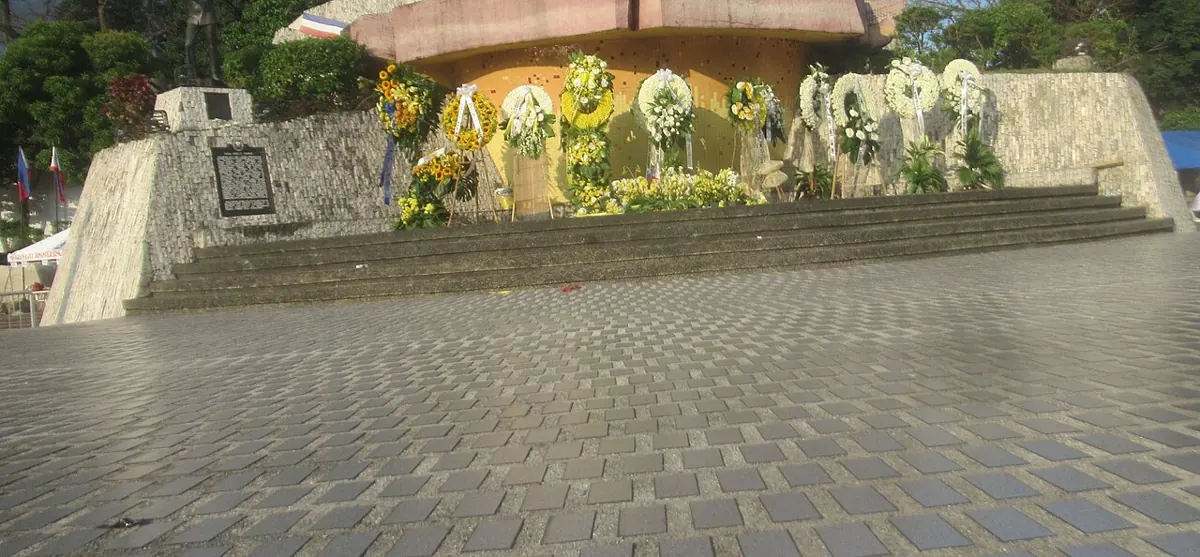
Every 25 February, commemorations are held at the EDSA Shrine (the Church of Mary, Queen of Peace at the corner of EDSA and Ortigas Avenue) and the People Power Monument in Quezon City. Schools often hold lessons and programs about the event.
The day's status has changed over the years: it has at times been a special non-working holiday and in other years a special working day, depending on the yearly presidential proclamation. If you are planning travel or work, check the official holiday list published by Malacañang for the current year, or use our festival calendar to see what else is happening.
In Cebu and Davao, observances tend to be smaller than in Manila, usually school activities, Masses and civic gatherings. Cebu has its own place in the story too: Cory Aquino was in Cebu City when the military breakaway began on 22 February, and she returned to Manila as events unfolded.
Where to learn more
- The EDSA People Power Commission and the National Historical Commission of the Philippines (nhcp.gov.ph) publish historical material.
- The Bantayog ng mga Bayani in Quezon City honours people who resisted martial law.
- Reliable history books and university libraries are better sources than social media posts, which often spread myths. Our guide on how to spot fake news in the Philippines and our fact check on the "Philippines was the richest country" claim can help.
For more on how major national events shape the country's history and geography, see our explainer on the Spratly Islands and West Philippine Sea.
Frequently Asked Questions
What is EDSA Revolution in simple words?
It was a peaceful four-day protest on EDSA in Metro Manila, from 22 to 25 February 1986, in which civilians and breakaway soldiers pushed President Ferdinand Marcos from power. Corazon Aquino became president as a result.
Why is it called EDSA?
The protests took place on Epifanio de los Santos Avenue, Metro Manila's main highway, between Camp Aguinaldo and Camp Crame. The road's initials became the name of the event.
Is EDSA Anniversary a holiday?
It depends on the year. 25 February has been declared either a special non-working day or a special working day by different presidential proclamations, so check the official list for the current year.
Who started the EDSA People Power Revolution?
The trigger was the breakaway of Defense Minister Juan Ponce Enrile and General Fidel Ramos on 22 February 1986, followed by Cardinal Jaime Sin's radio appeal for people to protect them. The huge civilian turnout is what made it a revolution.
What is EDSA II?
EDSA II refers to the January 2001 protests at the EDSA Shrine that led to President Joseph Estrada leaving office and Vice President Gloria Macapagal Arroyo taking over.