Who Owns the Spratly Islands? A Clear West Philippine Sea Guide
Six claimants, one 2016 ruling and thousands of fishermen caught in between. A plain-language guide to who claims the Spratly Islands and why it matters.
In this article
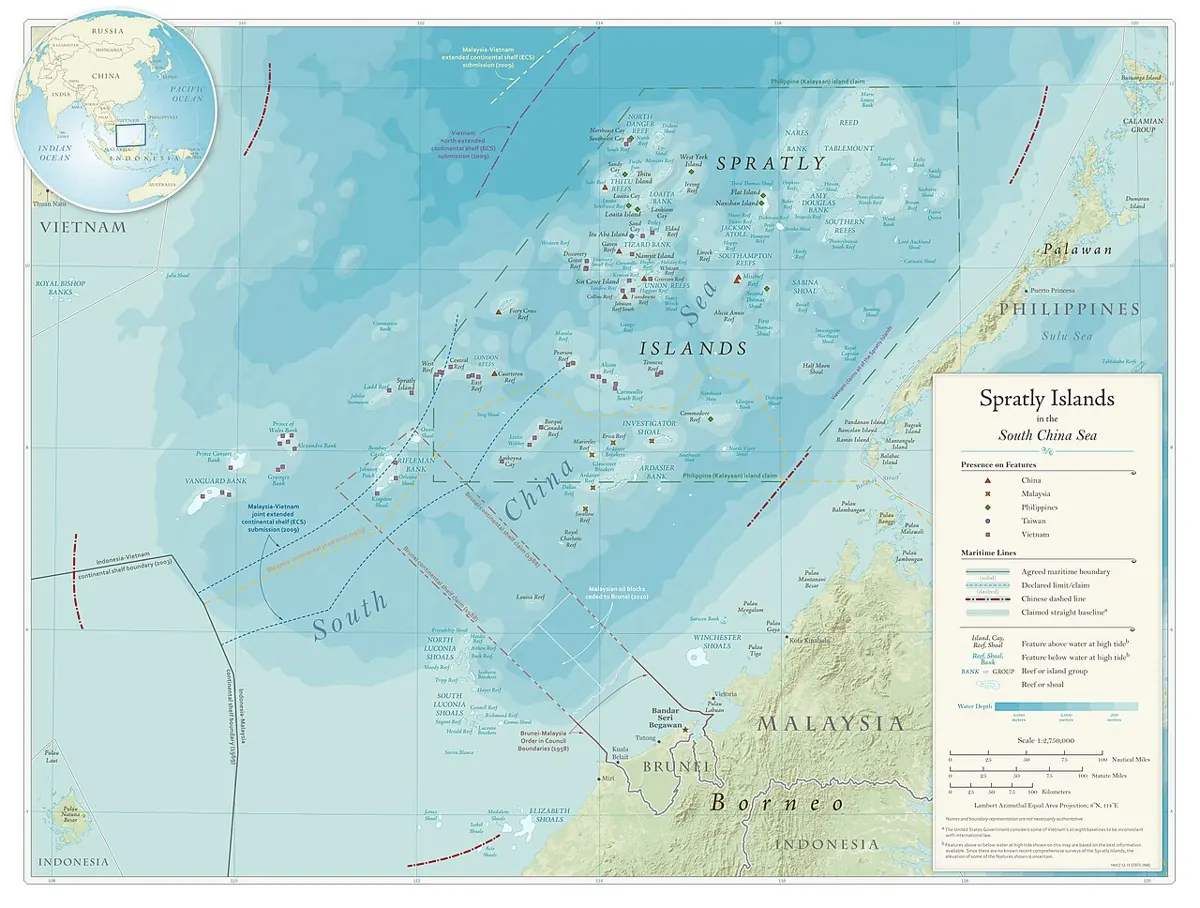
Who owns the Spratly Islands has no simple answer: no single country's sovereignty over all of them is accepted by everyone. China, Taiwan and Vietnam claim all or nearly all of the Spratlys, while the Philippines, Malaysia and Brunei claim parts. A 2016 international arbitral award clarified maritime rights under the law of the sea but did not decide who owns each island.
What Are the Spratly Islands?
The Spratlys are a scattered group of small islands, cays, reefs, shoals and rocks in the South China Sea. Many features are submerged at high tide, and even the largest natural islands are tiny. Together, though, they sit across rich fishing grounds and important shipping lanes, and the surrounding seabed is believed to hold oil and gas.
The Philippines calls the part of the South China Sea within its claimed maritime zones the West Philippine Sea, a name the government formally adopted in 2012.
Who Owns the Spratly Islands? The Claimants
| Claimant | Extent of claim | Notes |
|---|---|---|
| China | Almost the entire South China Sea, including the Spratlys | Based on the "nine-dash line" and historic claims |
| Taiwan | Similar to China's claim | Occupies Itu Aba (Taiping Island) |
| Vietnam | All of the Spratlys | Occupies the largest number of features |
| Philippines | Part of the Spratlys (the Kalayaan Island Group) | Occupies several features, including Pag-asa Island |
| Malaysia | Features in the southern Spratlys | Based on its continental shelf |
| Brunei | Maritime zone overlapping the southern area | Does not occupy any feature |
Several claimants have built facilities on the features they occupy. China, in particular, carried out large-scale land reclamation in the mid-2010s, turning reefs into artificial islands with runways and other infrastructure.
The Kalayaan Island Group and Pag-asa Island
The Philippines refers to its claimed portion as the Kalayaan Island Group (KIG). It is administered as the Municipality of Kalayaan, under the province of Palawan. The claim traces back to the 1950s, when Filipino explorer and lawyer Tomas Cloma declared a "Freedomland" in the area, and it was later formalised by the government in 1978.
The seat of the municipality is Pag-asa Island (internationally known as Thitu Island), one of the largest natural islands in the Spratlys. It has a small civilian population, a military presence and an airstrip. Pag-asa means "hope" in Filipino.
Another well-known site is Ayungin Shoal (Second Thomas Shoal), where the Philippines has kept a grounded navy ship, the BRP Sierra Madre, as an outpost since 1999. Resupply missions there have been the scene of repeated tense encounters.
The 2016 Arbitral Award
In 2013, the Philippines filed a case against China under the UN Convention on the Law of the Sea (UNCLOS). An arbitral tribunal, with the Permanent Court of Arbitration acting as registry, issued its award on July 12, 2016. Key points:
- No legal basis for historic rights claimed by China within the nine-dash line, to the extent they exceed UNCLOS entitlements.
- None of the Spratly features qualifies as a full "island" entitled to a 200-nautical-mile exclusive economic zone (EEZ). They are rocks or low-tide elevations under the law.
- Mischief Reef and Ayungin (Second Thomas) Shoal are within the Philippines' EEZ.
- China's activities, including large-scale reclamation and interference with Filipino fishing and petroleum exploration, violated Philippine sovereign rights in some areas.
The tribunal did not rule on which country has sovereignty over any island; that was outside its jurisdiction. China did not take part in the proceedings and has rejected the award. The Philippines and many other countries regard it as final and binding.
Why the Spratlys Matter to Filipinos
Fishermen and Livelihoods
For fishing communities in Palawan, Zambales and elsewhere, these waters are a source of food and income. Many Filipino fishermen have reported being blocked, chased or harassed at sea. Access to traditional fishing grounds is a daily concern, not an abstract legal debate.
Food Security and Resources
The area supports fisheries that feed millions across the region. Potential oil and gas resources also matter for energy security.
Trade and Security
A large share of global shipping passes through the South China Sea. Stability there affects trade, prices and security across Asia, including ports in Cebu and Davao.
Recent Developments, in Brief
Tensions have risen and eased over the years, with incidents involving water cannon, close manoeuvres and blocked resupply missions reported by the Philippine Coast Guard and the Armed Forces of the Philippines. In late 2024, the Philippines enacted laws defining its maritime zones and archipelagic sea lanes. Diplomatic talks continue alongside these tensions.
For the latest, follow trusted outlets in our news section and learn how to spot fake news, which is common on this topic. Official statements are published by the Department of Foreign Affairs.
Quick Glossary
| Term | Meaning |
|---|---|
| EEZ | Exclusive Economic Zone, up to 200 nautical miles from the baselines, with rights over resources |
| UNCLOS | UN Convention on the Law of the Sea, the main treaty on maritime rights |
| Nine-dash line | China's map line enclosing most of the South China Sea |
| Low-tide elevation | A feature above water only at low tide, which generates no territorial sea of its own |
| West Philippine Sea | The Philippine name for the parts of the South China Sea within its maritime zones |
For more Philippine history explainers, read about the EDSA People Power Revolution.
Frequently Asked Questions
Who really owns the Spratly Islands?
No single owner is recognised by all parties. China, Taiwan and Vietnam claim all or most of the islands, while the Philippines, Malaysia and Brunei claim parts. Each claimant occupies different features, except Brunei.
Did the Philippines win the 2016 arbitration?
The tribunal ruled largely in favour of the Philippines on maritime entitlements, finding no legal basis for China's historic rights claim beyond UNCLOS. It did not decide sovereignty over the islands, and China rejects the award.
What is the Kalayaan Island Group?
It is the Philippines' name for its claimed part of the Spratlys, governed as the Municipality of Kalayaan in Palawan. Its seat is Pag-asa Island.
Is the West Philippine Sea the same as the South China Sea?
The West Philippine Sea refers to the parts of the South China Sea within the Philippines' maritime zones. It is not a separate sea but a Philippine name for that area.